

The Air You Don’t See: How Compressed Air Quality Became Canada’s Quietest Competitive Advantage

Canada’s industrial sectors are under growing pressure, from tightening regulations and trade disruptions to rising quality expectations from global buyers. In this context, one utility often taken for granted is quietly becoming a competitive differentiator: oil-free, Class 0 compressed air. For food processors, pharmaceutical manufacturers, and electronics producers, clean air is no longer a bonus, it’s the baseline. It’s why IVYS selected ELGi as its compressor partner for the Canadian market, a manufacturer whose engineering standards were built around exactly this reality.
A Manufacturing Sector
Where Compliance Is Non-Negotiable
Canada’s food and beverage processing industry generated $173.4 billion in manufactured goods in 2024, representing over 20% of total national manufacturing output and employing more than 318,000 workers. The pharmaceutical market is equally significant, sitting at roughly $33 billion USD in 2024 and projected to reach nearly $50 billion by 2033, driven by an aging population and the rapid growth of specialty biologics.
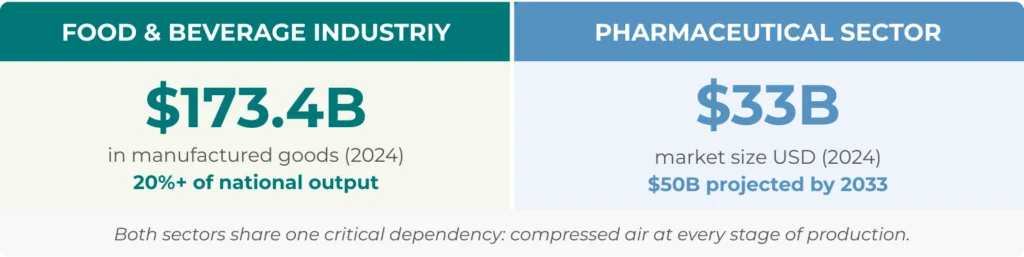
Both sectors share a critical operational dependency: compressed air. Virtually every stage of production, mixing, conveying, filling, packaging, and instrumentation, relies on it. And in regulated industries, the quality of that air is directly tied to the safety of the end product. The international benchmark, ISO 8573-1 Class 0, defines the strictest purity level: zero detectable oil content, whether in aerosol or vapor form. In Canada, the Canadian Food Inspection Agency (CFIA) and Good Manufacturing Practice (GMP) standards for pharmaceuticals align directly with this threshold.
Compressed Air as a Hidden Risk Factor
Even though compressed air is used in almost every industrial facility, people still rarely audit or inspect its quality. In facilities still running oil-lubricated compressors, even those equipped with multi-stage filtration systems, the risk of contamination is never fully eliminated. It’s managed, not resolved.
Oil-lubricated systems can introduce residual oil aerosols, particulates, and even microorganisms into the downstream air supply. Filtration can partially compensate, but it introduces pressure drops, ongoing maintenance costs, and additional failure points. A saturated filter element, a missed replacement cycle, or an improperly installed cartridge, and the integrity of an entire production run can be compromised.
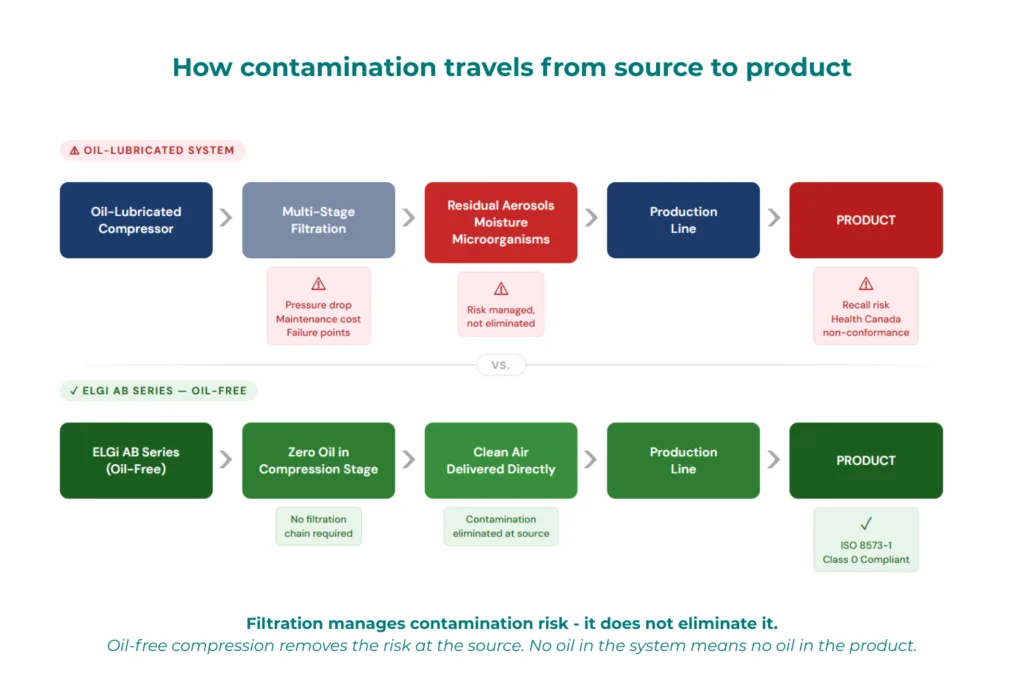
The business consequences are real. Product recalls in Canada’s food sector can run into tens of millions of dollars in direct costs, not counting brand damage. In pharmaceuticals, a non-conformance finding from Health Canada can result in production halts or manufacturing license suspension. The risk isn’t theoretical, it’s operational.
Oil-Free Technology: From Compliance Cost to Operational Advantage
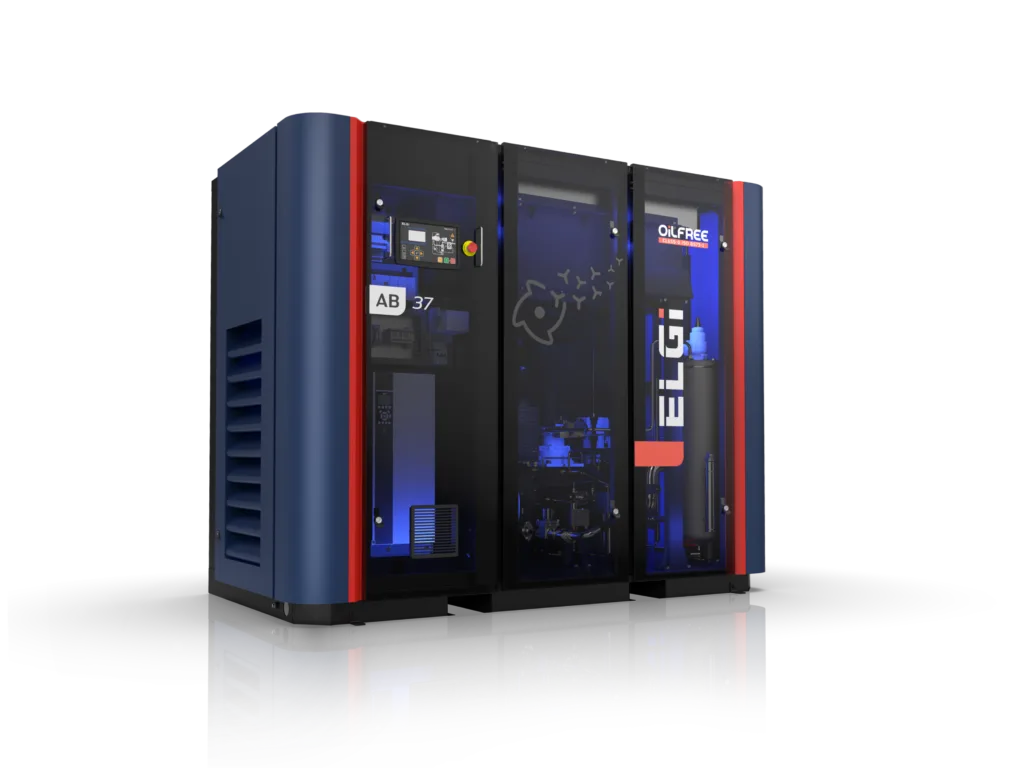
The technology has matured to a point where oil-free no longer means underpowered or high-maintenance. Next-generation oil-free screw compressors, such as the ELGi AB Series (15–100 HP), certified ISO 8573-1 Class 0 per the 2010 standard, eliminate the contamination risk at the source rather than managing it downstream.
ELGi backs the AB Series with a 5-year warranty on major components and a 5-year package warranty, an uncommonly long commitment in the compressor market, and one that aligns directly with how Canadian plant managers actually plan capital assets: on 10 to 15-year depreciation cycles. When a manufacturer stands behind a machine for five years, it changes the risk calculus of the purchase entirely.
Key features driving adoption in Canadian industrial settings:
- FDA-approved stainless-steel rotors with proprietary anti-corrosion coating, zero oil in the compression stage, no downstream risk
- Closed-loop water circuit replacing oil as both lubricant and coolant, eliminating the need for reverse osmosis systems and reducing both energy and maintenance costs
- Compliance with ISO 8573-7:2003 for microbiological content, critical for food, pharma, and electronics
- Simplified compliance documentation: with a certified Class 0 system, the filtration chain becomes shorter, easier to audit, and more defensible with regulators
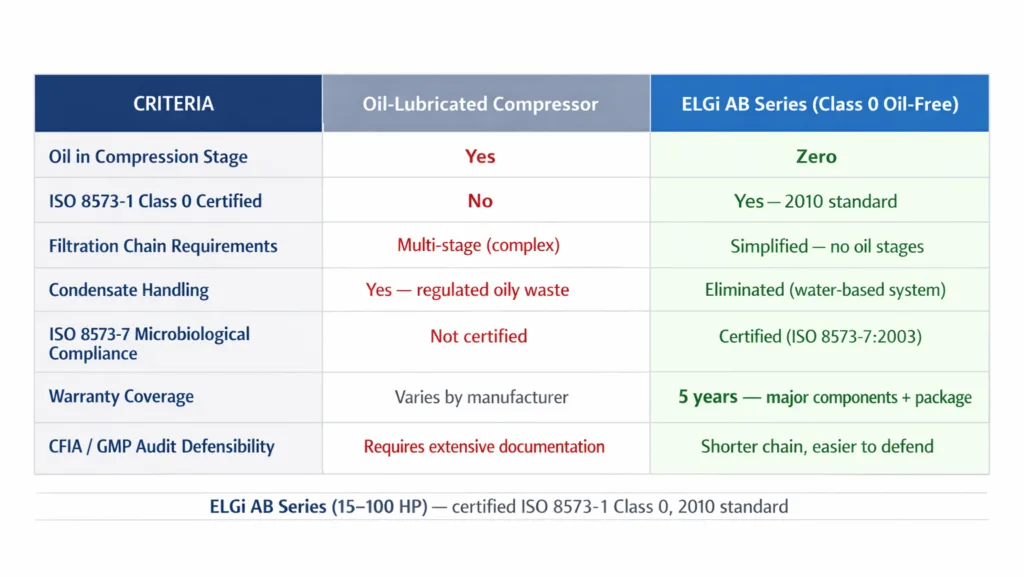
For a compressor dealer or systems integrator, this translates to a practical sales argument: customers who move to Class 0 reduce their audit exposure, simplify their quality management systems, and remove one of the most common root causes of contamination-related downtime.
A Canadian Lens: Regulation, Resilience, and Sustainability
The case for oil-free compressed air takes on added weight in the Canadian context for three reasons.
Regulatory precision
The CFIA mandates that compressed air in direct or indirect contact with food must be free of contaminants, with oil content below 0.01 mg/m³ and a dew point of -40°C or lower. This is exactly Class 0, achievable with the ELGi AB Series paired with a desiccant air dryer, a combination that addresses both oil purity and dew point requirements in a single, auditable system. ELGi’s AB Series is certified to this standard under the 2010 revision of ISO 8573-1, which matters significantly when defending compliance to a CFIA auditor. Companies operating below this standard are not just underperforming technically, they are exposed to real regulatory risk.
Operational resilience
An oil-free compressor with lower maintenance requirements and no oil change schedule increases operational resilience. Less external dependence, fewer consumables to stock, fewer service interventions to manage.
Environmental accountability
Oil-lubricated compressor systems generate oil-contaminated condensate that must be managed as an industrial waste product under Canadian environmental regulations. Any facility knowingly discharging oil-contaminated water faces serious legal liability. Eliminating oil from the compression stage removes this compliance burden entirely.
How It Changes Day-to-Day Operations
At IVYS, we work with plant engineers and operations managers who face this reality consistently: compressed air is everywhere in the facility, but its quality is rarely audited with the rigor it deserves, until something goes wrong.
Our approach integrates compressed air quality thinking from system design forward, not as an afterthought. This systems-level perspective, rather than a component-by-component approach, is what separates a system that barely meets regulatory minimums from one that genuinely protects production quality.
For industrial buyers, this shifts the conversation from purchase price to total cost of ownership: energy savings, reduced maintenance, eliminated oil disposal costs, and lower risk of costly production interruptions.
The Real Cost of “Free” Air
Compressed air is often called the fourth utility of the plant floor, alongside water, gas, and electricity. But unlike the other three, its quality is still too frequently underestimated, until the consequences arrive in the form of a failed audit, a product recall, or an unexpected shutdown.
In an environment where Canadian manufacturers are competing on quality, navigating tighter regulations, and building more resilient operations, clean air is not a luxury specification. It’s a foundational requirement. This is precisely why IVYS partnered with ELGi, one of the few global compressor manufacturers to have built oil-free, Class 0 performance into its core product line rather than treating it as a premium option. The AB Series isn’t a compliance workaround. It’s a system designed from the ground up to eliminate contamination risk, reduce total cost of ownership, and hold up under the scrutiny of regulated Canadian industries. Companies that make the move to Class 0 today are not just buying a better compressor, they are investing in the credibility of their product, the reliability of their operations, and their ability to grow in a more demanding market.
At IVYS, we’re excited to bring ELGi’s oil-free air compressor technology to the Canadian market. Backed by proven engineering excellence, this partnership reflects our commitment to introducing solutions that are purpose-built for performance, reliability, and long-term value. Together with ELGi, we’re raising the standard for clean air in Canadian industry.