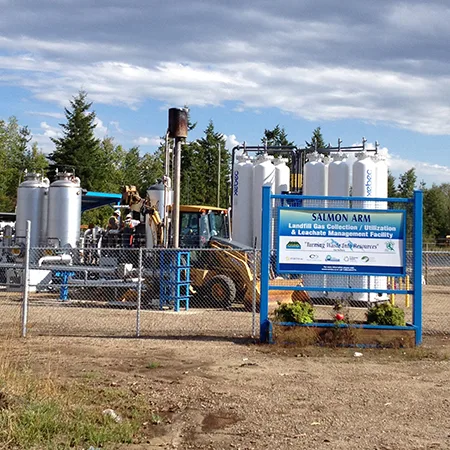
Salmon Arm, BC, CANADA
Biogas Upgrading from Landfill Gas
Project details
Technology: PSA and balance of plant
Commissioned: 2013
Biogas Source: Landfill
Pipeline: Fortis BC
Specifications
Capacity: 290Nm³/h /180 SCFM
Raw Gas Composition: 54% CH₄, 40.44% CO₂
5.18% N₂, 230ppm H₂S, 100%RH
Design Specifications RNG / Biomethane: 97% CH₄, 2% CO₂
Power Consumption of Biogas Upgrading Plant:
< 0.25 kW PSA only
British Columbia’s first landfill-gas-to-pipeline RNG plant runs on an IVYS PSA
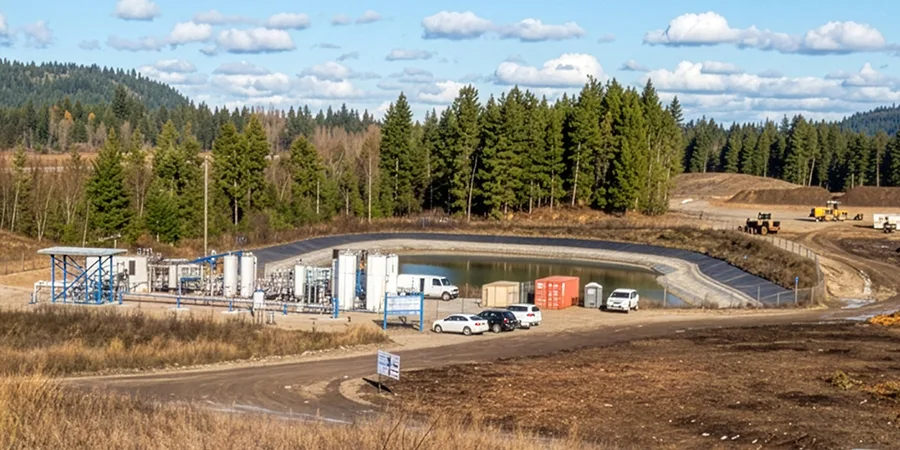
At the Salmon Arm Landfill in British Columbia, an IVYS skid-mounted pressure swing adsorption (PSA) upgrading plant processes 290 Nm³/h of raw landfill gas into pipeline-quality renewable natural gas (RNG) for FortisBC customers. This was the first project in British Columbia to upgrade landfill gas to pipeline-quality RNG and is among the smallest landfill sites in North America to attempt it.
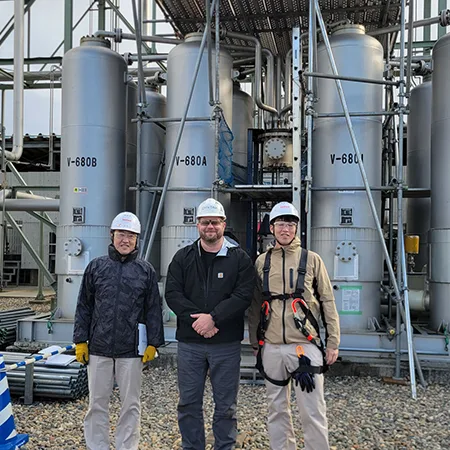
Three partners worked together to make the project a success. Columbia Shuswap Regional District (CSRD) owns and operates the landfill, and financed and built the gas wells, vacuum blowers, and standby flare. FortisBC operates the upgrading plant and purchases the gas for its distribution network. IVYS (then Xebec Adsorption) designed, built, and supplied the complete upgrading plant to FortisBC, from pre-treatment through PSA and controls, and continues to support the plant in service.
The Challenge: Pipeline RNG from a Small Landfill
The Salmon Arm Landfill holds about 360,000 tonnes of waste on a 25-hectare footprint. When CSRD closed its first phase in 2010, it installed gas wells and began flaring the gas. Upgrading that gas to pipeline quality meant solving several problems at once:
- Small, variable flow: design flow was only 290 Nm³/h (181 SCFM).
- More N₂ than expected: on-site gas analysis found 5.18% N₂ in the landfill gas, higher than first assumed.
- Contaminants: H₂S, siloxanes and volatile organics, all of which must be removed before the PSA.
- First of its kind: no landfill in BC had yet delivered upgraded gas into a utility pipeline
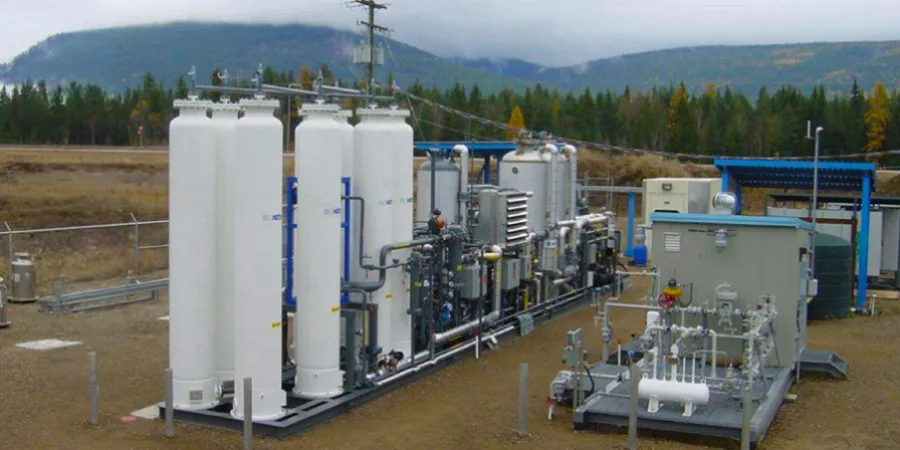
The Solution: A Complete Skid-Mounted Upgrading Plant
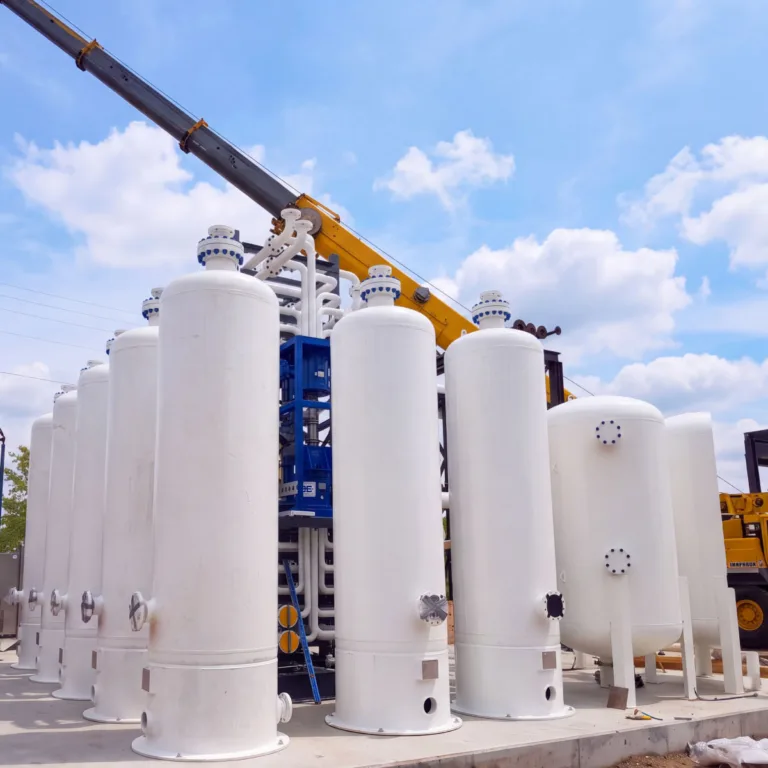
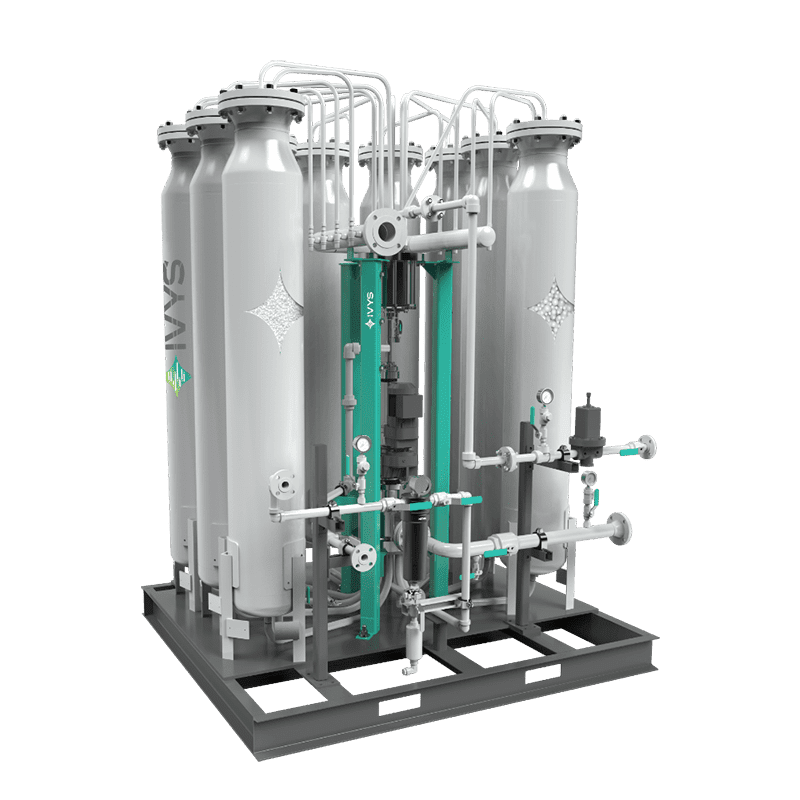
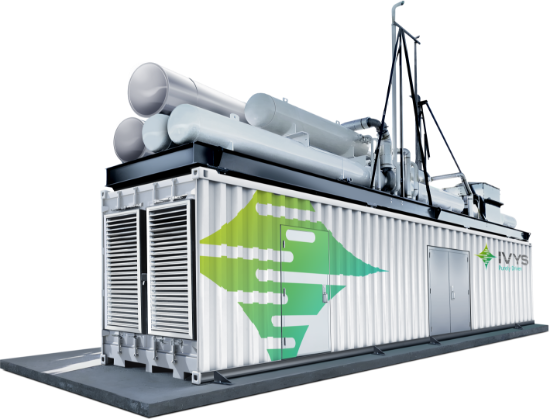
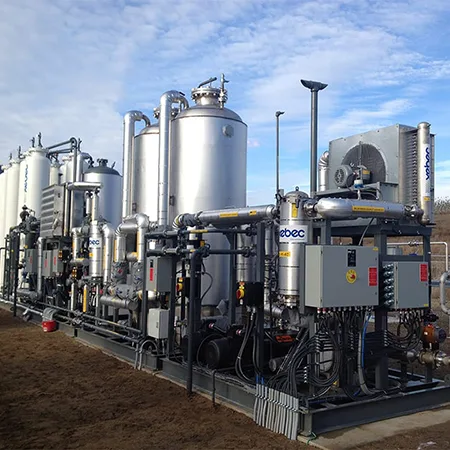
IVYS supplied a nine-module upgrading plant assembled on five skids, with piping and wiring installed at the factory to reduce field work.
How the gas moves through the plant:
- Pre-treatment: a feed blower takes the low-pressure landfill gas and removes liquids.
- H₂S removal: media beds cut H₂S to pipeline limits
- Compression and conditioning: the gas is compressed, cooled and dried.
- Siloxane removal: activated carbon strips siloxanes and volatile organics to protect the PSA adsorbent.
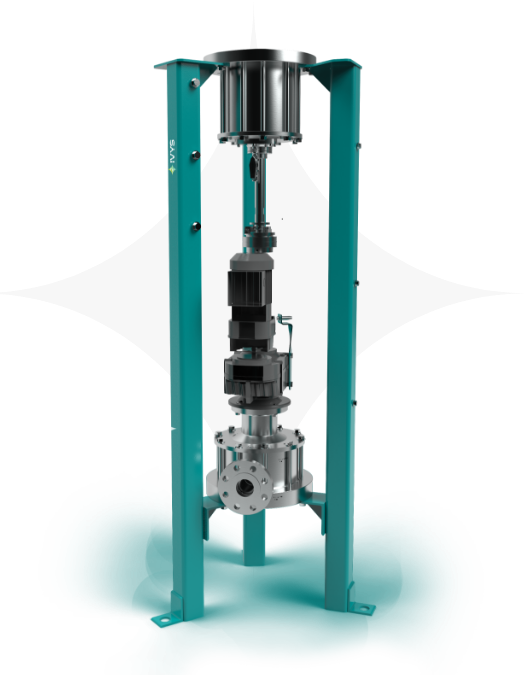
- PSA: A fast-cycle rotary valve PSA with adsorbent beds removes CO₂ and part of the N₂ in one step. Vacuum pumps regenerate the beds.
- Product delivery: RNG is ready for injection into FortisBC’s nearby distribution line.
FortisBC estimated the plant could supply up to 25,000 GJ of RNG a year, about enough to heat 300 homes.
Awards and Government Support
The project won the 2012 Federation of Canadian Municipalities (FCM) Sustainable Communities Award in the waste category. CSRD also received a UBCM Climate Action Award for the methane capture project.
Provincial funding helped make the business case work for BC Bioenergy Network, including a $200,000 grant toward the biogas clean-up facility. The Province of BC’s Innovative Clean Energy (ICE) Fund also provided a grant that, together with BCBN, supported the project; CSRD reports the combined funding at $366,000. Because the landfill falls below the threshold in BC’s Landfill Gas Regulation, CSRD can sell the emissions reductions it generates. By 2018, these carbon credits had brought in about $727,000 and helped CSRD become carbon neutral.
Small Sites Can Make Pipeline RNG
Salmon Arm shows that even a landfill with just a few hundred thousand tonnes in place can produce pipeline-grade RNG instead of flaring its gas.
- Sized for small landfills: a compact plant built around 290 Nm³/h of feed, with 50% turndown as gas flow changes.
- Design follows the real gas: the PSA was re-selected after on-site analysis showed higher N₂, so the product still met specification.
- Complete package: one supplier for pre-treatment, H₂S and siloxane removal, compression, PSA
- Simple valve hardware: IVYS rotary valves replace the banks of switching valves found in conventional PSA systems.